
Last night at 3:30 am local time (UTC-3) a cargo ship passing two and a half miles behind Nakee’s starboard quarter had me awake and monitoring the situation from the comfort of my aft cabin bunk. This is possible as I’ve installed a bracket on the ceiling above my bunk into which I can securely mount my iPad. I’ve also installed a USB charging port in the ceiling to keep it charged and a VHF handset. I can then join the inside chart plotter’s proprietary WiFi network and using the Ray Remote app, mirror the Raymarine chart plotter’s screen on the iPad. Since the chart plotter also allows control of the autopilot, I can – if necessary – also change course without getting out of my bunk, assuming no change in sail plan is necessary. Typically a 10° or 20° change in course is sufficient to comply with the collision regulations and avoid getting too close to other ships, but is generally not enough to require going into the cockpit to adjust lines. This might sound a bit over the top to coastal sailors, but it makes a lot of sense on long ocean passages. Radar and AIS proximity alarms give plenty of advance warning.

While awake I saw that the wind speed had increased from 8-10 kts to 15-19 kts and backed around from 260° to 215° putting us on a course well North of Ponta Delgada, needlessly lowering our VMG. I knew we would need to tack the genoa to change course but decided to wait until the morning to do so, as we were still goose-winging with a poled-out genoa and I didn’t fancy getting the crew up on deck at “reef o’clock” unless absolutely necessary.
So, around 7:00 local time this morning we got up and furled the genoa, stowed the spinnaker pole back on the mast, tacked the boat, unfurled the genoa on the port side, adjusted the preventer on the boom, and changed course so our COG now equals the BTW of 84°, making our VMG equal to our SOG of around 6 to 7 kts. DTW to Ponta Delgada is now 750 nm as I type this. We hope to arrive there on Thursday next week, but that is still rather uncertain as it all depends on the wind direction and strength.
As we were able to run the watermaker yesterday, I was having a bit of a wash last night in the aft head’s shower stall (that has a seat to prevent falls). When I had my head full of shampoo, the fresh water stopped flowing. It took me a while, working blindly, to towel off and put some shorts on. I called out to the crew and they confirmed that the fresh water pump was still switched on at the main switch board, suggesting a problem with the fresh water pump down in the engine room. My heart sank as I don’t have a spare water pump on board.
With soap stinging in my eyes, I went under the galley sink and moved the valves to allow the manual foot-pump-operated tap to be used to manually pump fresh water so I could get the soap out of my eyes. Those valves are normally set so that the same tap can be used to test the water maker’s output before it is sent into the water tank, but having the ability to access fresh water even when electrics fail is an important safety feature at sea.
It was about 21:00 local time, so we delayed turning in for the night and took apart the cushions in the main salon to get out the electrical tool box. We the removed all the contents of the storage under the port settee to gain access to the port side of the engine room.
Equipped with knee-pads, tools and a head lamp, I climbed down into the engine room and maneuvered myself forward, past the main engine to reach behind the new generator, where the fresh water pump is located. This was not so easy, as the boat was rolling quite a lot, being on a downwind point of sail and there are a lot of sharp obstacles in the engine room. It was also quite warm down there, the generator having been run while Kelvin baked a (rather tasty) cottage pie for our dinner.
On inspecting the wiring to the pump I noticed that the quick electrical connector for the negative wires was corroded. Touching them caused the pump to jump to life, as it is operated by a pressure switch, and my attempt to shampoo had removed the pressure from the system.
So I cleaned up the ends of the copper wires, some of which are unfortunately not tinned and were rather corroded. I replaced the corroded quick connector with a new one, and the pump worked again.
I climbed back out, re-stacked the locker above the entrance to the engine room, replaced the settee cushions. We replaced the electrical tool box and thought “job done” and we could all resume getting ready for bed.
While attempting to brush my teeth, the pump stopped again. So, all over again, tool box back out, back into the engine room, and this time I trimmed off some of the most corroded wire ends, got the pump working again, climbed back out, re-stacked everything, tool box away. Went back to finish brushing my teeth, pump stopped again. So for the third time last night, un-stacked everything, tool box out, back into engine room, trimmed some more ends of wires, pump working again, back out, re-stack. Finish brushing teeth.
Then, when someone was refilling their water bottle in prep for turning in, the pump stopped again! i groaned very loudly but decided to give up for the night, so we turned in without running water and left the problem solving for this morning.
This morning it took me two more iterations of engine room quests to finally discover a slightly loose spade connector on the relay wired up to the fresh water pump.
Why a relay is needed on the fresh water (and any) pump is another lesson learned the hard way in February 2023 when I was in Trinidad and lost my fresh water. It turns out the amps pulled through the pump’s undersized pressure switch eventually burns the pressure switch out and the pump stops working. And no, one does not need to buy an entire new pump (which would anyway eventually suffer the same fate), but finding a new proprietary pressure switch in the back of beyond is very, very difficult. By the time the same thing happened to my salt water anchor chain wash-down pump, I remembered the lesson taught me by the marine electrician in Trinidad and now carry spare relays and pressure switches so was able to repair that pump on my own.
So, with five iterations of engine room quests at sea, our fingers are now crossed in hopes that the water pump keeps on pumping. It is only 10:00 am and I’m ready for a nap!
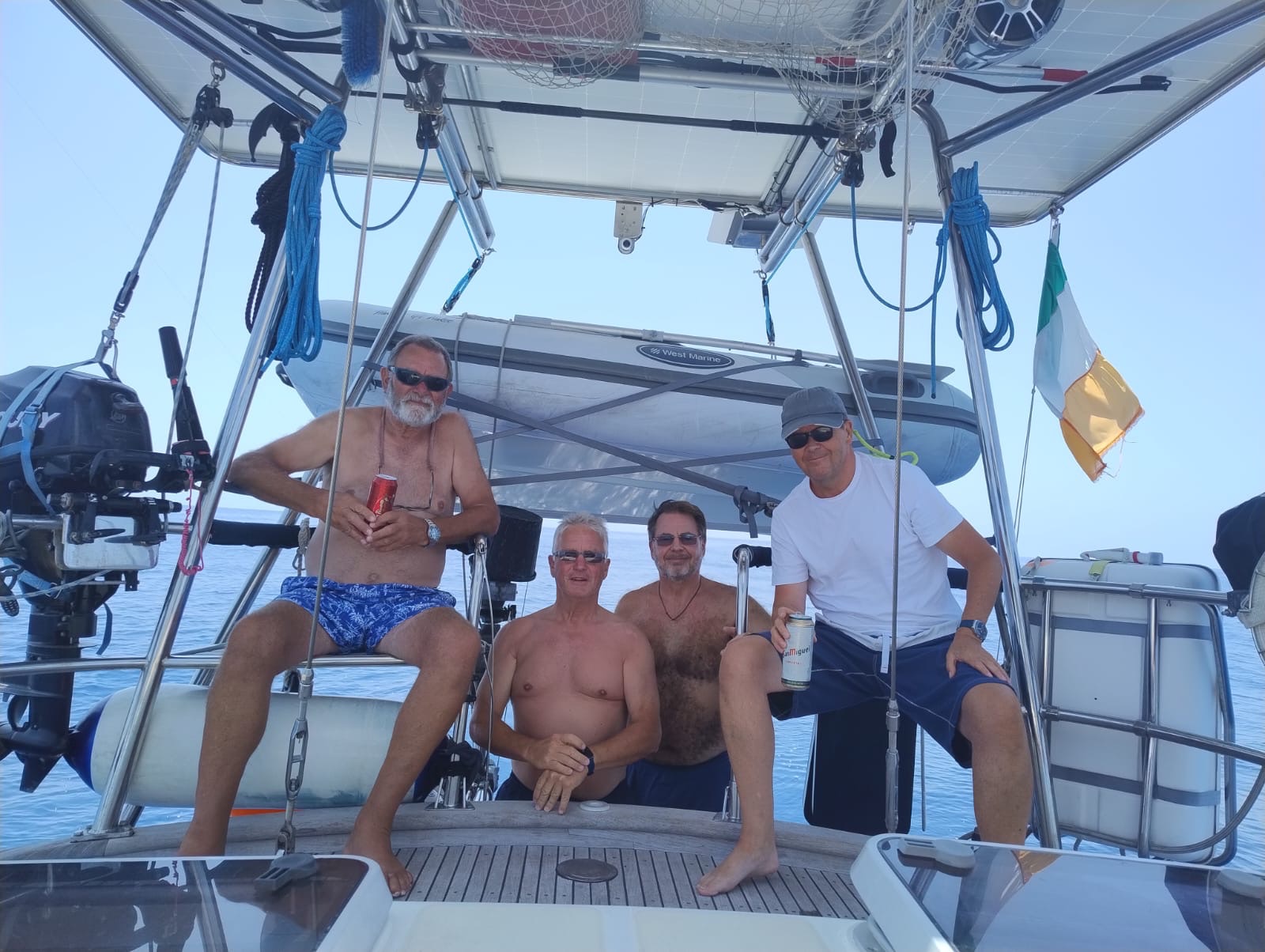


Sailing is solving problems that other people never have.. 😅
Good luck and hopefully a good sleep next time!